European & American antiques, hunted by Tim & Sue Roush.
Tim and Sue hunt estate sales across the Midwest several times a week — finding furniture, lighting, and folk art for collectors, interior designers, home stagers, and film, TV & theatre productions.
Two dealers with a good eye and a full tank of gas.
Tim and Sue Roush are the whole operation — out at estate sales and auctions across the Midwest most weeks, then back at their booth inside Gillham House Antiques, in the historic Stine & McClure building. They trade in European and American antiques — pieces that earn their place in a room and hold it for the next hundred years.
The inventory turns over constantly, so the booth is never the same twice. Carved cupboards and alabaster light one week, folk weathervanes and a cast-iron pig named Frank the next. The hunt is the point — and it's what lets them track down specific pieces for designers, stagers, and productions on request.
Inside the booth · Gillham House
Who we help
Buying, staging, or dressing a set — start here.
Tim and Sue work with private collectors and with the trade. Tell them what a room, a listing, or a scene needs, and they'll hunt it down.
Recent examples of what Tim and Sue turn up — not a live availability list. Pieces sell in person at the booth and come and go quickly; the fastest way to see what's in now is @roush_antiques.
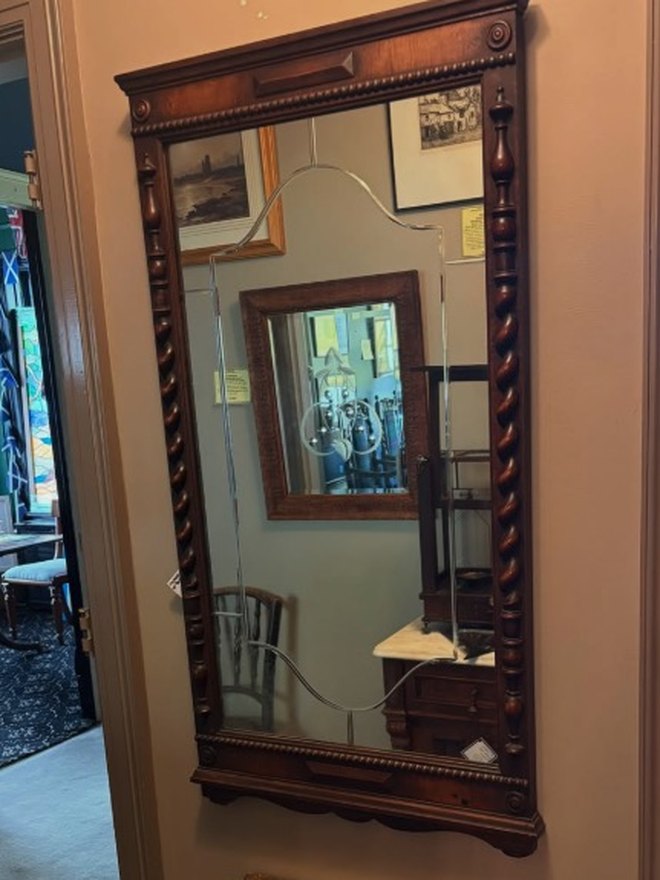
Walnut columns turned in a tight spiral run down both sides, with a beaded cornice overhead and rosette blocks at the corners. There's a shaped little shelf across the bottom, so it works in an entry where something has to hold the keys.
At the booth
No. 193
Gilt Rococo Pier Mirror
Giltwood · pierced crest · mirrored borders
The crest is cut clean through — scrolls and a spray of plumes standing open against the wall above the glass. Narrow mirrored panels run down each side of the main plate, so the gilt catches light from both edges. Tall and narrow, for the wall nobody knows what to do with.
At the booth
No. 197
Carved Gilt Frame Mirror
Giltwood · carved foliate molding · foxed plate
A deep frame with foliate scrollwork carved right around the outer molding and a plain gilt lip holding the glass. The plate has gone lightly foxed, which is the part people either love or want replaced.
At the booth
No. 201
Round Scalloped Mirror
Round · scalloped bevel · glass edge
The scallop is cut into the glass itself, so the edge waves all the way around with the bevel following it. Hangs flat and bright over a sideboard and takes up less visual room than a framed mirror the same size.
At the booth
No. 177
Ship's Wheel Chandelier
Mahogany wheel · brass sockets · dolphin mounts
A mahogany ship's wheel turned into a light — brass sockets standing up between the spokes, brass stars set around the rim, and a pair of cast dolphins curling around the stem. It hangs low over a table and does all the talking in the room.
At the booth
No. 181
Gilt & Ebonized Floor Mirror
Beveled glass · gilt corner scrolls · black frame
A black frame with gilt scrollwork piled into every corner, and the glass beveled with an etched border running around the inside. Tall enough to lean against the wall and brighten up a dark corner.
At the booth
No. 185
Monk Print Triptych
Quartersawn oak frames · set of three
Three cellar-monk prints, each in its own quartersawn oak frame, with a little carved shelf and applied brass on the middle one. They hang as a set and want a long wall.
At the booth
No. 145
Dutch Refectory Table
Oak · draw-leaf ends · bulbous legs
Solid oak with draw leaves at each end and legs turned thick as fence posts. It came with six carved chairs and enough seats for the whole holiday.
At the booth
No. 149
Hand-Painted Floor Mirror
Mahogany · painted panels · inlaid border
Someone painted flowers straight onto the frame and edged it with a border of tiny inlaid diamonds. Big enough to check your whole outfit and pretty enough to keep for the frame alone.
At the booth
No. 153
Satinwood Crest Mirror
Satinwood · shaped crest · painted florals
A shaped crest with a spray of flowers hand-painted across the golden satinwood, gilt leaves tucked in the corners. The kind of mirror that dresses up a plain wall in a hurry.
At the booth
No. 157
Neoclassical Walnut Mirror
Walnut · dentil cornice · reeded frame
Reeded walnut with a little dentil cornice up top and rosettes at the corners — quiet and correct. It leans anywhere and behaves itself.
At the booth
No. 161
Art Deco Waterfall Wardrobe
Figured walnut · rounded “waterfall” doors
Figured walnut with those rounded waterfall edges the 1930s loved. That's the hand-painted “Endeavour” campaign chest keeping it company — a story for another day.
At the booth
No. 165
Open Bookcase on Stand
Walnut · three drawers · Queen Anne legs
Open shelves over three little drawers, up on cabriole legs so it never feels heavy. Made to hold books and show them off at the same time.
At the booth
No. 169
Pair of Bouillotte Lamps
Gilt brass · black tole shades · a pair
A matched pair, gilt brass with black tole shades that tilt down to keep the glare off. Two of them, which is the hard part — pairs almost never stay together this long.
At the booth
No. 173
Upholstered Iron Bench
Cast-iron scroll frame · damask seat
A long window bench on a scrolled cast-iron frame, dressed in red damask. Heavy, elegant, and built to sit under a window and get used.
At the booth
No. 085
Georgian Knife Chest
Mahogany · serpentine front · brass mounts
An 18th-century knife box with the key still in the lock. Beauty is in the details on this one — the figure in the mahogany runs like water.
At the booth
No. 089
French Marquetry Commode
Bombé form · floral marquetry · marble top
Bowed front, flowers laid in wood, a slab of veined marble across the top. It anchors a room and makes everything near it look better.
At the booth
No. 093
Burl-Walnut Gentleman's Dresser
English · figured burl walnut · inlaid
Figured walnut with fine inlaid banding on every drawer. We bought it for the handles — pierced brass, cut by hand, no two quite alike.
At the booth
No. 097
Empire Mahogany Chest
Mahogany · gallery back · glass pulls
A big, honest chest with a mirrored figure to the wood and its original pressed-glass pulls. It held one family's table linens for the better part of a century.
At the booth
No. 101
Ball-and-Claw Dining Table
Hand-carved · cabriole legs · claw feet
Carved apron, acanthus knees, ball-and-claw feet that grip the floor. Built back when a table was meant to outlive the family that bought it.
At the booth
No. 105
Slant-Front Bureau
Oak · fitted interior · drop front
Drop the front and the whole interior opens up — pigeonholes, little drawers, a secret or two. Someone wrote a lot of letters at this desk.
At the booth
No. 109
Leather-Top Writing Table
Mahogany · tooled leather · on casters
Slender legs, brass casters, a tooled leather top gone the perfect shade of oxblood. It rolled out of an estate library and straight onto our floor.
At the booth
No. 113
Marble-Top Library Table
Walnut · rouge marble · single drawer
One long drawer, turned legs, a rouge-marble top with real cold weight to it. Set a lamp and a stack of books on it and you're done.
At the booth
No. 117
Ebonized Open Bookcase
Ebonized wood · gilt-line trim · low & long
Black-lacquered and ruled with fine gilt lines. Long enough to run under a window and hold every book you've been meaning to shelve.
At the booth
No. 121
Tall Cheval Mirror
Mahogany frame · full length
Nearly floor to ceiling in a dark mahogany frame. It leaned in the hall of an old Hyde Park house for decades — you can tell by how kind the glass is.
At the booth
No. 125
Antique Dress Form
“Wolf Model,” 1966 · collapsible · size 32
A collapsible tailor's form, stamped 1966. She stays by the door in whatever beads came in that week, greeting everyone who walks the aisle.
At the booth
No. 129
Hand-Knotted Medallion Rug
Wool · deep red ground · central medallion
A big central medallion on a deep red field, wool with real luster underfoot. Worn soft in all the right places — this one was walked on and loved.
At the booth
No. 133
Marble Column Lamp
Rouge marble · Corinthian capital · brass base
A rouge-marble column on a stepped brass base with a Corinthian capital up top. Warm light and good bones.
At the booth
No. 137
Carved Plume Wall Bracket
Mahogany · shell-and-plume form · one of a pair
Carved to read like a great fluted plume, finished in deep mahogany with a gilt tip. One of a pair we found flanking an old mantel.
At the booth
No. 141
Etched-Glass Casket
Beveled glass · wheel-cut ferns · silvered mounts
A little mystery — beveled panels, wheel-cut ferns, a silvered gallery crowned with an urn. We think it's a Victorian dresser casket. Come argue with us about it.
The story behind a piece — where it came from, why it stopped him in the aisle.
Field Note
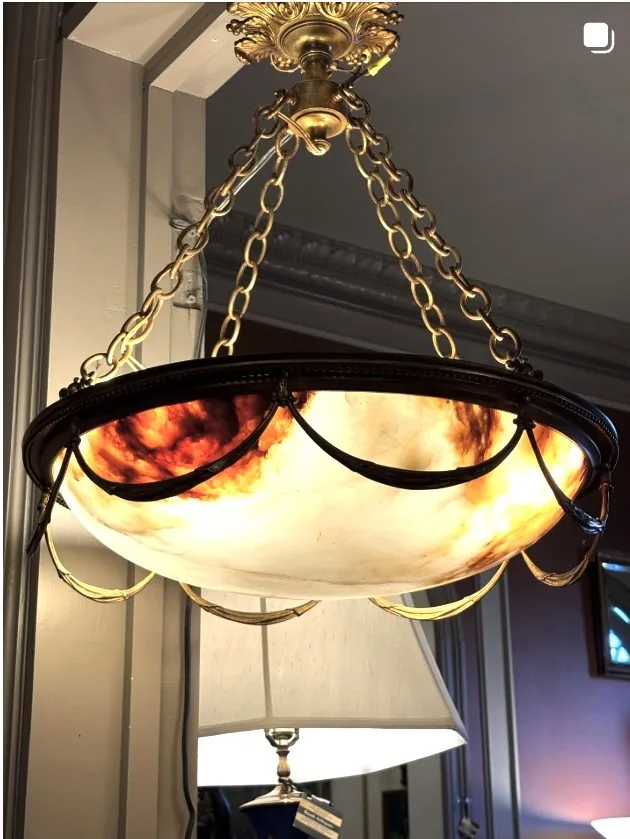
The Alabaster Chandelier
I almost walked past this one. It was hanging in a back room under a bare bulb, the alabaster gone gray with dust. But alabaster keeps its best trick hidden until there's light behind it. We got it home, wired it up, and the whole bowl lit like a slice of agate — warm amber veins you'd never guess were in there. Worth the crick in my neck getting it down.
— Tim
Field Note
“Frank”
Every booth needs one piece that stays even after everything else sells. Frank is ours. He came out of a farm estate with his paint mostly worn off and a handwritten tag still tied on — my name is frank. We kept the tag. He's cast iron, heavy as a cinder block, and the most photographed thing we own. Kids come back just to say hi to him.
— Tim
Field Note
The Italian Painted Cabinet
This one stops people in the aisle. Two portraits painted right on the doors — a young man and a young woman, looking at each other across the latch. The paint is original, crackled the way only real age does it. I don't know their names and I never will. Somebody painted them with a lot of care a long time ago, and now they get to keep watching the room.
— Tim
Field Note
The Knife Chest
Two hundred years ago somebody paid a small fortune to keep their good silver in style. That's what this is — a mahogany knife box, serpentine front, brass handle worn smooth by hands long gone. The key still turns. I lift the lid for people just to watch their faces when the whole thing swings open like it was made yesterday. They built the ordinary things beautiful back then.
— Tim
Field Note
The Dress Form
She's a Wolf Model, stamped 1966, and she came to us bare. Now she wears whatever beads walk in the door that week, and she's earned a spot right up front. Half the folks who stop think she's for sale. Some days she is. Mostly she just stands there greeting people, which is honest work for a dress form.
— Tim
Field Note
The Burl-Walnut Dresser
I bought this one for the handles. Somebody cut those brass pulls by hand — little pierced pagodas, and if you look close, no two are exactly the same. The walnut is all burl, laid up in matched panels with a thread of inlay running the edges. It's the kind of English piece that got handed down until a family finally ran out of children to hand it to.
— Tim
Field Note
The Red Rug
A rug like this took someone a whole winter, maybe two, knot by knot. The red has gone soft and warm the way good wool does with fifty years of bare feet on it. There's a spot near the middle worn lighter than the rest — that's where a favorite chair sat, I'd bet on it. You buy the whole history when you buy the rug.
— Tim
Find us
Inside Gillham House Antiques.
One historic building, seven dealers, a genuinely good afternoon of browsing. Roush Antiques sits among a curated group in the Stine & McClure building on Gillham Plaza — worth the trip on its own.
In good company: Mockingbird Mercantile · Don Moore Antiques · Still Antiques · Roush Antiques · Pat Postans Antiques · Don Fields Antiques · Diebolt's
For designers & set decorators: source pieces for interiors, staging, and film & TV sets — email roush0128@gmail.com or DM @roush_antiques.
Inventory changes constantly and lives on the @roush_antiques Instagram feed — that's the best way to see current pieces, along with a visit to the booth on Friday or Saturday.
How do I find the Roush Antiques booth?
Roush Antiques is one of seven dealers inside Gillham House Antiques at 3235 Gillham Plaza. Once inside, look for the Roush Antiques booth or ask staff to point you to it.
Do you work with interior designers, stagers, and productions?